Most businesses do not start looking for inbound call center companies because things are going well. They start looking because something has already slipped. A spike in call volume nobody planned for. A long hold time that turned into a bad review. A new market that the current setup simply cannot support.
That is usually the real starting point. Not a feature checklist. A moment where the current system stopped keeping up.
Once that search begins, the options multiply fast. Some providers are pure technology platforms. Some are large, established players with decades of enterprise contracts. Some are newer cloud-native vendors built specifically for distributed teams. On paper, many of them look interchangeable.
They are not.
The difference between a provider that quietly strengthens a support operation and one that becomes another internal headache rarely shows up in a sales deck. It shows up six months in, when call volume climbs, agents are working from three different cities, and the system either holds up or does not.
Why this decision is harder than it looks
Evaluating inbound call center companies is not really a software decision. It is an operations decision wearing a software disguise.
A platform can have an impressive feature list and still fail a business in practice. Routing logic that looks sophisticated in a demo can fall apart under real call volume. An IVR that seems intuitive to the vendor can frustrate actual customers within the first week.
That is why so many evaluations stall. Teams compare pricing tiers and integration logos, but they are not always comparing what actually matters: how the platform performs when real call volume, real agents, and real customer expectations are involved.
What actually separates high-performing providers
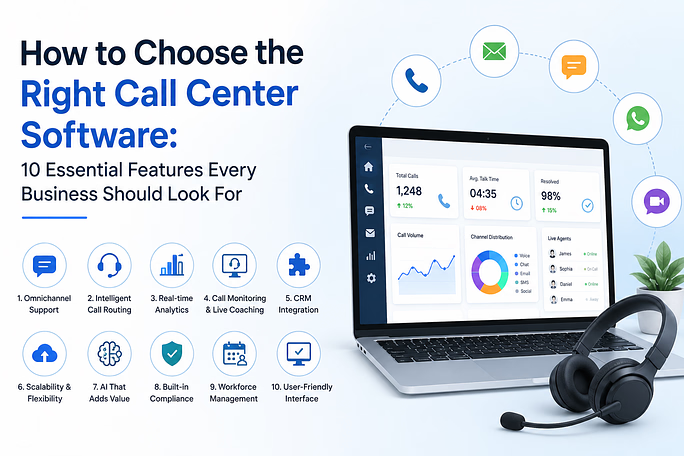
The strongest inbound call center companies tend to share a few traits that are easy to overlook during a demo but become obvious during day-to-day use.
They route calls based on context, not just availability.
Many platforms route calls to the next available agent. High-performing providers route based on the caller’s needs, the required skill, and the existing history with that customer. That difference alone can significantly change first-call resolution rates.
They give agents the full picture before the call connects.
Agents should not be piecing together a customer’s history while the customer is already talking. The better providers surface prior interactions, account context, and relevant notes the moment a call comes in, not after the agent has to dig for them.
They scale without forcing a redesign
Plenty of platforms work fine at low volume but start to crack under pressure. Strong providers are built to handle growth, seasonal spikes, and distributed agent teams without requiring a new system every time the business expands.
They report on what leadership actually needs to know
Generic dashboards are easy to build. Useful ones are not. The providers worth paying attention to offer reporting that connects call data to real outcomes: resolution time, repeat contact rate, agent performance, and where bottlenecks are forming.
They do not treat reliability as an afterthought
Uptime, redundancy, and failover are not marketing language. They are the difference between a missed call during a peak period and one that gets answered without anyone noticing there was ever a risk.
Where many providers fall short
Some of the more established names in this space, the ones every shortlist tends to include, built their platforms for a different era of customer support. Powerful systems, but often complex to configure, slower to adapt, and priced for enterprise budgets with enterprise-length implementation timelines.
Newer providers solve part of that problem, but sometimes swing too far toward simplicity. Easy to set up, but lacking the depth that larger or more complex support operations require as volume grows.
The gap in the middle, platforms that are genuinely easy to deploy but still built for real operational complexity, is smaller than the market suggests.
What businesses should evaluate before making a decision
A useful evaluation does not start with feature comparisons. It starts with a few honest questions.
What happens to call quality during a volume spike, not a controlled demo?
How long does it actually take to get agents live on the platform?
Can the reporting answer a direct question from leadership without first exporting three spreadsheets?
Does the provider’s roadmap align with where the business is headed in 12 months, or only with where it is today?
Those questions tend to separate providers fast. Not every platform built for inbound support is built for the version of the business that exists eighteen months from now.
Why businesses still invest in inbound call center companies
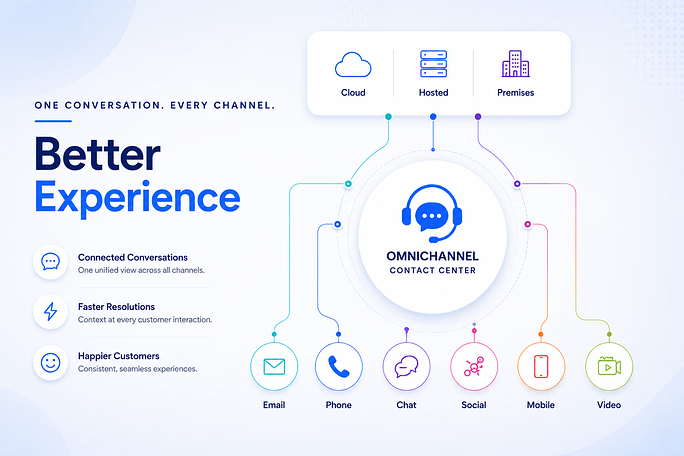
Many customer conversations now happen through chat, messaging, and email.
Yet voice remains one of the fastest ways to resolve complex issues. Even as digital channels continue to grow, customers still turn to voice when an issue is urgent, high-value, or difficult to resolve through chat or email.
That is why businesses continue investing in inbound call center companies, especially when customer experience, service quality, and first-call resolution are priorities.
The strongest providers help businesses maintain service quality as demand grows. They make it easier to manage distributed teams, improve first-call resolution, and maintain a consistent customer experience even during busy periods.
The goal is not simply answering more calls.
It is creating a support experience that remains consistent as customer expectations continue to rise.
Where Telerain fits into that comparison
As support teams grow, keeping service levels consistent becomes harder.
Telerain simplifies that challenge by routing calls to the right teams, giving agents the context they need, and making support operations easier to manage as demand grows.
For businesses evaluating inbound call center companies, that often matters more than a long list of features.
The right provider is rarely the one with the longest feature list. It is the one that performs the way a business needs it to, on the days that actually test it.
That is why the best inbound call center companies are not measured by what they promise during a demo.
They are measured by how well they support customers, agents, and operations over the long term.