“Can we push this to next quarter?”
If you’ve ever been part of a conversation about replacing a contact center platform, you’ve probably heard someone ask that question.
Not because the business doesn’t believe in cloud technology.
Not because leadership isn’t convinced by AI, automation, or omnichannel customer service.
The hesitation usually comes from somewhere much more human.
“What happens if our customers feel the impact?”
That’s the question that keeps customer service leaders, operations managers, and IT teams awake at night.
Technology can be replaced.
Customer trust takes years to earn and only a few poor experiences to lose.
Imagine it’s 9:02 on a Monday morning.
Your new cloud contact center software went live over the weekend.
The first calls are already coming in.
Live chat notifications begin appearing.
WhatsApp messages are waiting.
Email queues are filling up.
Your support team is logging in for the first time.
Your customers have absolutely no idea you’ve migrated.
And honestly, they shouldn’t.
The customer calling about a delayed shipment doesn’t care that you’re implementing a new Contact Center as a Service (CCaaS) platform.
The patient trying to reschedule an appointment isn’t interested in whether your CRM integration completed overnight.
The business owner following up on an urgent payment doesn’t know you’ve introduced AI-powered routing or a new Interactive Voice Response (IVR) system. They expect exactly what they received last week.
Someone answers. Someone already knows who they are. Someone solves the problem without asking them to repeat their story.
Customers rarely remember the technology behind a great experience. They remember how easy you made it to get help.
And that’s why migrating to cloud contact center software is never really about software.
It’s about protecting every customer conversation while preparing your business for the next stage of growth.
If you’re planning a migration, you’re probably trying to answer three questions.
- How do we move without disrupting customer service?
- What mistakes most often cause contact center migrations to fail?
- How do we choose a platform that will still support our business five years from now?
Let us dive into the journey and learn what actually works.
Why businesses wait longer than they should
Here’s something we’ve consistently noticed while working with organizations modernizing their customer experience.
Very few businesses delay migration because they don’t believe in cloud technology.
They delay it because they’re trying to protect what’s already working.
Customer service is different from almost every other business function.
If your accounting software changes, your finance team notices.
If your HR platform changes, your employees notice.
But when your contact center changes.
Your customers notice.
That’s a much bigger responsibility.
Every operations leader has imagined the same Monday morning.
Longer queues.
Agents trying to learn a new interface while customers wait.
A CRM record that doesn’t load.
An Automatic Call Distribution (ACD) rule sending customers to the wrong queue.
A supervisor comparing today’s dashboard with yesterday’s report because something doesn’t look right.
Those situations rarely happen because businesses choose the wrong platform.
More often, they happen because uncertainty feels bigger than preparation.
So the project gets postponed.
“Let’s wait until after the holiday season.”
“Let’s finish the product launch first.”
“Maybe next quarter.”
According to Salesforce’s State of Service research, customers increasingly expect connected, personalized experiences regardless of how they choose to contact a business. Those expectations continue to rise every year. Customers no longer think in channels.
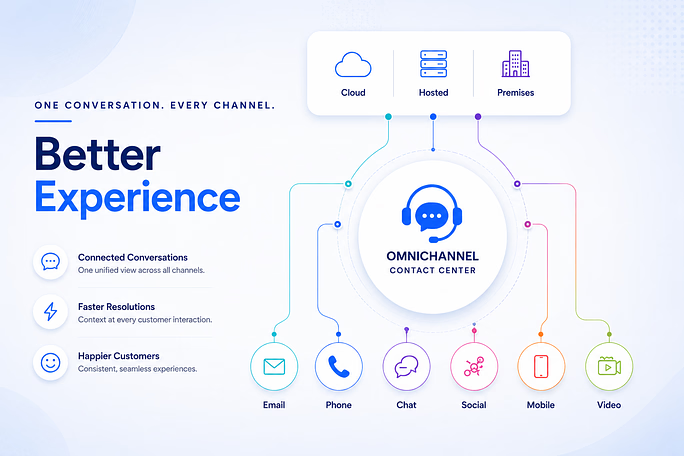
They don’t distinguish between voice, email, live chat, WhatsApp, SMS, or social messaging.
To them, it’s one conversation.
They expect:
- Agents to know who they are.
- Customer history to follow them across every interaction.
- Intelligent routing to connect them with the right person the first time.
- Faster resolutions without repeating information.
Unfortunately, many legacy contact centers weren’t built for those expectations.
Instead of one connected customer journey, businesses end up managing disconnected systems.
Customer records sit in one application.
Call recordings live somewhere else.
Email conversations are stored in another platform.
Knowledge articles are managed separately.
Workforce Engagement Management (WEM) has its own dashboard.
Reporting and analytics often require yet another tool.
Agents spend more time navigating systems than serving customers.
One customer conversation suddenly requires four or five different screens.
We have learned over the years is this. Businesses rarely regret moving to the cloud.
They regret waiting until customer expectations have already outgrown their existing platform.
That’s usually the moment leadership realizes the challenge isn’t simply maintaining old technology. It’s protecting customer experience while preparing for future growth.
That’s when cloud contact center software stops being an IT discussion and becomes a business strategy.
Because the real objective isn’t to modernize infrastructure.
It’s to create faster, more connected, more personalized customer experiences while making everyday work easier for the people delivering them.
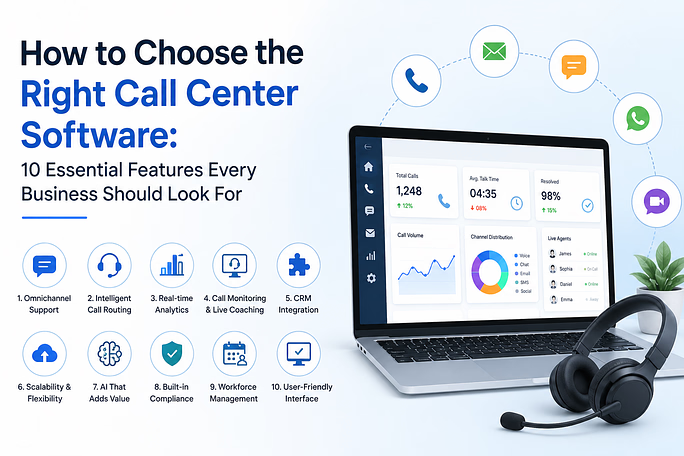
Modern cloud contact center software combines omnichannel communication, CRM integration, AI-powered Agent Assist, conversational AI, workforce optimization, analytics, automation, and customer journey intelligence into a single connected platform.
When those pieces work together, customers don’t notice the technology.
They simply notice that doing business with you feels easier.
And that’s exactly how a successful migration should feel.
The biggest misconception about migrating to cloud contact center software
One of the biggest misconceptions is that migrating to cloud contact center software is a technology project. It isn’t.
Technology is usually the easiest part. People are the real migration.
Think about your support agents for a moment.
Last Friday, they knew exactly where everything was.
- Customer history.
- Call recordings.
- Knowledge articles.
- Previous tickets.
- Internal notes.
Years of experience had created muscle memory. They weren’t thinking about where to click next. Their attention was exactly where it belonged, on the customer.
Now it’s Monday morning.
The platform is new. The interface looks different.
Even simple tasks take a little longer.
Not because the software is difficult.
Because every human needs time to build confidence with something unfamiliar.
That’s completely normal.
Businesses often spend months evaluating vendors, comparing features, testing integrations, and planning infrastructure. Yet they sometimes give the people using the platform only a few hours to prepare.
The software performs exactly as expected. The people don’t. And that’s where frustration begins.
Successful migrations don’t invest only in implementation. They invest in adoption.
Because confident agents create confident customers.
The first week tells you more than six months of planning
Every migration plan looks impressive in a presentation.
Real customers rarely follow presentations.
We have seen pilot projects uncover small issues that never appeared during testing.
One support team realized agents were taking three unnecessary clicks just to verify a customer’s identity.
Another discovered supervisors needed different real-time dashboards because queue visibility alone wasn’t enough during peak hours.
One organization found customer conversations were reaching the right agents through Automatic Call Distribution (ACD), but the knowledge base wasn’t surfacing relevant articles quickly enough, adding precious seconds to every interaction.
None of these issues suggested the migration had failed. They simply highlighted something every experienced customer experience leader understands.
Customers always teach you something your project plan couldn’t.
That’s why successful migrations don’t chase perfection on day one.
They focus on continuous improvement.
Every adjustment makes the next thousand customer conversations better than the last thousand.
Why phased migrations outperform big-bang launches
There’s something reassuring about announcing,
“Everyone moves to the new platform on Monday.”
It sounds decisive. It sounds efficient. It also creates unnecessary pressure.
The strongest migrations we’ve seen usually begin much smaller.
One customer support team.
One regional office.
One business unit.
Sometimes even one communication channel.
The objective isn’t to move slowly.
It’s to learn quickly.
Every pilot uncovers valuable insights.
- Agents suggest faster workflows.
- Supervisors request additional reporting.
- Quality managers identify coaching opportunities.
- IT teams fine-tune CRM integrations, Workforce Engagement Management (WEM), identity systems, knowledge management, analytics, and business applications before expanding further.
Each improvement benefits everyone who joins next.
By the time the entire organization adopts cloud contact center software, the platform no longer feels unfamiliar.
It simply feels like the way work gets done.
That’s how confidence spreads across a business.
Not through presentations.
Through experience.
Legacy contact center vs. cloud contact center software
The decision to modernize isn’t about replacing old technology.
It’s about removing friction from every customer interaction.
| On-premise infrastructure | Cloud-native Contact Center as a Service (CCaaS) |
| Manual upgrades | Automatic platform updates |
| Voice-first communication | Omnichannel communication across voice, email, live chat, WhatsApp, SMS, and social messaging |
| Separate customer records | Unified customer journey with CRM integration |
| Limited remote work | Secure work from anywhere |
| Basic IVR and routing | Intelligent IVR, skills-based routing, AI-powered routing, and Automatic Call Distribution |
| Manual reporting | Real-time analytics, speech analytics, quality management, and customer sentiment insights |
| Manual after-call work | AI-powered Agent Assist, conversation summaries, workflow automation, and Generative AI |
The technology matters. But what matters even more is what the technology enables.
Agents spend less time searching.
Supervisors spend less time building reports.
Customers spend less time waiting.
That’s the real value of cloud contact center software. It’s not about adding another tool to your technology stack. It’s about creating a single, connected experience for both customers and agents.
A practical migration framework that works
Every organization has different goals, but successful migrations usually follow the same rhythm.
They begin with customer conversations.
Not technology.
Ask simple questions first.
- Where do customers wait the longest?
- Which communication channels generate the highest volume?
- Where do agents spend unnecessary time switching between systems?
- Which interactions create the highest customer effort?
Those answers tell you far more than any product demonstration.
Next, map every integration supporting those conversations.
- CRM.
- ERP.
- Helpdesk.
- Knowledge management.
- Identity systems.
- Payment applications.
- Business intelligence.
- Workforce Optimization (WFO).
- Quality management.
The objective isn’t simply connecting software.
It’s making information available the moment agents need it.
Then prepare your people.
The most confident agents aren’t always the fastest learners.
They are the ones who had enough time to explore, practice, ask questions, and build confidence before speaking with customers.
Finally, measure migration success through customer outcomes.
Not technical milestones.
Customers don’t celebrate successful deployments.
They notice shorter wait times.
Higher first-contact resolution.
Fewer transfers.
More personalized conversations.
Better experiences.
That’s what success looks like.
Migration checklist for cloud contact center software
Before migration
- Understand customer journeys across every communication channel.
- Review workflows and remove unnecessary manual steps.
- Validate CRM, ticketing, workforce management, analytics, reporting, and business integrations.
- Define measurable success metrics including CSAT, FCR, AHT, SLA compliance, customer effort score, and agent productivity.
- Train supervisors and agents using real customer scenarios.
- Start with one pilot team before expanding.
After migration
- Monitor customer feedback every day.
- Review routing accuracy and queue performance.
- Gather agent feedback regularly.
- Fine-tune workflows using operational insights.
- Continue optimizing AI, automation, reporting, and customer journeys.
Migration isn’t the finish line.
It’s the beginning of continuous improvement.
How to evaluate cloud contact center software before making a decision
Choosing cloud contact center software isn’t simply about replacing today’s platform.
It’s about choosing how your business will serve customers for years to come.
One mistake we often see is businesses comparing feature lists before understanding what they actually need.
A vendor may promise hundreds of capabilities.
But if agents still struggle to find customer information or supervisors still spend hours creating reports, those extra features won’t improve customer experience.
Instead, ask questions that reflect how your business actually operates.
- Can it integrate seamlessly with your CRM, ERP, and business applications?
- Does it support voice, email, live chat, WhatsApp, SMS, and future communication channels from one interface?
- Can AI summarize conversations, recommend responses, and reduce repetitive work without replacing the human conversation?
- Will supervisors receive meaningful operational insights instead of static reports?
- Can it scale as your business grows into new markets, teams, and languages?
Most importantly, ask your frontline teams.
Support agents often identify usability challenges long before leadership notices them.
The best buying decisions happen when IT, operations, supervisors, and agents evaluate the platform together.
Because cloud contact center software isn’t simply another software purchase.
It’s the foundation of your customer experience strategy.
That’s the philosophy behind Telerain.
Telerain combines omnichannel communication, AI-powered Agent Assist, CRM integration, IVR, intelligent routing, speech analytics, quality management, Workforce Engagement Management, workflow automation, real-time analytics, and Generative AI into one unified platform.
Instead of asking teams to work across disconnected systems, it creates one connected workspace where every customer interaction has context, every conversation continues naturally, and every agent has the information they need to deliver exceptional service.
Technology becomes invisible.
Customer experience becomes memorable.
Frequently asked questions
What is cloud contact center software?
Cloud contact center software is a cloud-based customer communication platform that helps businesses manage voice calls, email, live chat, WhatsApp, SMS, social messaging, and other customer interactions through a single unified interface. Modern platforms also include AI-powered Agent Assist, CRM integration, analytics, workforce management, and automation.
How is cloud contact center software different from an on-premise contact center?
Traditional contact centers rely on on-site infrastructure, manual upgrades, and limited scalability. Cloud platforms provide automatic updates, remote access, omnichannel communication, AI capabilities, reduced maintenance, and the flexibility to scale without replacing infrastructure.
Can cloud contact center software integrate with CRM platforms?
Yes. Most enterprise platforms integrate with CRM solutions such as Salesforce, Microsoft Dynamics, HubSpot, Zoho CRM, and other business applications, allowing agents to view complete customer history without switching between systems.
Is cloud contact center software suitable for small and medium-sized businesses?
Absolutely. Cloud platforms scale with business growth, allowing organizations to start with a small team and expand their user base, channels, AI capabilities, and locations as customer demand increases.
Will AI replace contact center agents?
No.
AI works best as an assistant, not a replacement.
It can summarize conversations, recommend responses, automate repetitive tasks, surface knowledge articles, and reduce after-call work, allowing agents to focus on empathy, critical thinking, and building stronger customer relationships.
The conversations your customers never notice
Five years from now:
No one in your business will remember the exact migration timeline.
Nobody will remember the vendor demonstrations.
Nobody will remember the weekend your new platform went live.
Your customers certainly won’t.
What they will remember is something much simpler.
When they needed help.
Someone answered quickly. Someone already understood their queries and resolved them.
They didn’t have to repeat themselves.
Their problem was solved without unnecessary transfers.
The conversation felt effortless.
That’s what every investment in cloud contact center software should ultimately deliver.
Not better technology. Better conversations.
Because technology will continue to evolve.
Customer expectations certainly will.
The businesses that succeed won’t be the ones with the longest feature list.
They’ll be the ones that make every customer interaction feel personal, connected, and remarkably easy.
That’s the future of customer experience. And for organizations investing in long-term customer relationships, that’s no longer optional; it’s the competitive advantage.
And that’s exactly what modern cloud contact center software is designed to make possible.