Omnichannel contact center solutions: How businesses improve customer support across every channel
Most customer support issues do not begin when a system crashes. They begin much earlier, when communication stops flowing as customers expect.A customer may start on live chat, follow up on email, switch to SMS, and call when the issue becomes urgent. For them, it is still one conversation. They expect the business to know what has already happened.
Most customer support issues do not begin when a system crashes. They begin much earlier, when communication stops flowing as customers expect.A customer may start on live chat, follow up on email, switch to SMS, and call when the issue becomes urgent. For them, it is still one conversation. They expect the business to know what has already happened.
But for many companies, that is exactly where support begins to slow down.
One conversation gets split across tools. Teams move between dashboards. Agents lose context. Customers repeat themselves. What feels like a small delay internally often becomes frustration externally.
That is the real gap modern businesses are trying to solve.
Customer expectations have changed, but many support systems were built for a much simpler model. They were designed around tickets, queues, and separate channels. Today, businesses are expected to manage connected conversations across multiple touchpoints.
That is exactly why companies are investing in an omnichannel contact center. Not because they need more tools, but because they need communication to work as one connected experience.
Why customer support becomes inconsistent across channels
Most businesses already have multiple support channels. Voice, email, live chat, WhatsApp, SMS, and messaging apps are common across customer-facing teams.
Most businesses already have multiple support channels. Voice, email, live chat, WhatsApp, SMS, and messaging apps are common across customer-facing teams.
The problem is not availability. The problem is consistency.
When those channels work separately, support begins breaking in small but expensive ways. A customer explains the same issue twice. An agent searches across tools for context. A team responds late because visibility is limited.
That is where disconnected communication starts affecting more than support. According to PwC, 73% of customers say customer experience plays a major role in purchasing decisions. So when support feels fragmented, it directly affects trust, retention, and long-term revenue.
What an omnichannel contact center actually does
Many businesses still confuse multichannel support with omnichannel support.
Multichannel means customers can contact a business through different platforms. Omnichannel means those platforms are connected.
That difference matters because customers do not think in channels. They think in one conversation.
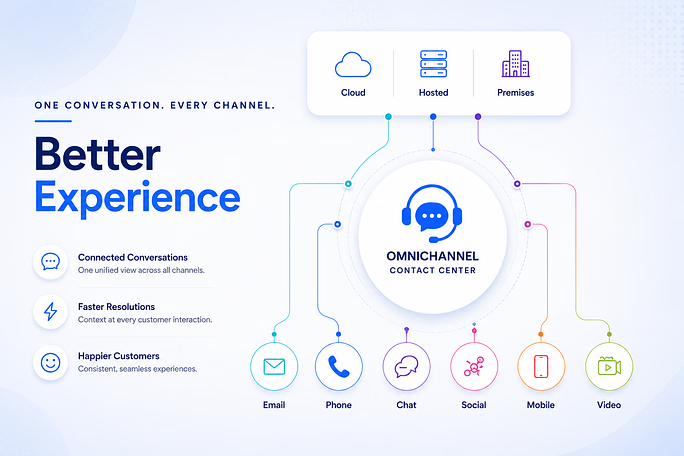
An omnichannel contact center brings together voice, chat, email, SMS, and messaging into a single, connected support environment. Instead of treating every interaction like a fresh issue, it creates continuity across the full customer journey.
That helps businesses:
- Keep customer history visible across touchpoints
- Reduce repeated conversations
- Improve response consistency
- Give agents real-time context
- Speed up issue resolution
That is when support starts to feel seamless rather than scattered.
Why traditional support systems are slowing businesses down
Traditional support systems were built for a simpler support model. A request came in, it was assigned, and it moved through a queue. That worked when customer service happened mostly on one channel.
Today, support rarely works that way. A customer may begin in chat, continue through email, and escalate to voice, expecting the business to know what already happened.
When every touchpoint feels disconnected, friction builds quickly.
Traditional systems often create slowdowns because:
- Channels operate in silos
- Agents lose visibility across conversations
- Workflows depend heavily on manual routing
- Reporting becomes fragmented
- Scaling support becomes harder
Nothing may appear broken on the surface. But underneath, teams lose efficiency, and customers feel the delay.
That is one reason Gartner reports that 80% of organizations expect to compete primarily on customer experience.
How omnichannel support improves customer service
The biggest shift is not adding more tools. It is improving how communication flows.
When support channels are connected, teams stop wasting time jumping between systems.
They spend more time solving customer issues.
They spend more time solving customer issues.
That directly improves customer support in practical ways.
Faster response times
Agents can instantly access the full customer journey instead of searching across separate platforms.
Better customer consistency
Customers do not need to repeat the same issue when moving between channels.
Higher team productivity
Less manual effort means teams spend more time on real problem-solving.
Smarter reporting
Leaders can track performance across voice, chat, email, and messaging in one place.
Easier scalability
As support volume grows, businesses can support hybrid teams, expand operations, and improve service without rebuilding workflows.
This is where an omnichannel contact center becomes a business advantage, not just a support tool.
What businesses should evaluate before choosing a solution?
This is where many teams make the wrong decision. They compare features, dashboards, and pricing before asking whether the platform actually supports how their business communicates.
A stronger evaluation starts with operational needs.
Can the platform unify support channels into one flow?
Can agents instantly access customer history?
Does automation reduce manual effort?
Can reporting remain centralized as support scales?
Can agents instantly access customer history?
Does automation reduce manual effort?
Can reporting remain centralized as support scales?
Those questions matter more than feature overload.
The goal is not to buy more software.
The goal is to remove friction from communication.
The right omnichannel contact center should make support easier, faster, and more connected, especially for distributed support teams handling customer interactions across multiple touchpoints.
Omnichannel contact center vs disconnected support tools
The difference becomes clearer as businesses grow.
Disconnected tools may offer multiple support channels, but visibility often stays limited. Teams still operate across isolated systems.
An omnichannel contact center changes that by connecting communication into one environment.
With disconnected tools, businesses often deal with:
- Repeated customer explanations
- Slower issue resolution
- Manual handoffs
- Fragmented reporting
- Reduced agent visibility
With omnichannel support, businesses gain:
- Unified customer context
- Connected workflows
- Faster support handling
- Better team coordination
- Centralized reporting
- Stronger CX consistency
That is why enterprise support teams are shifting toward connected communication models.
Why enterprise CX leaders focus on connected support
Modern CX platforms all prioritize one thing: connected customer journeys. They are not just improving ticket handling. They are improving communication across every touchpoint.
That matters because support now impacts much more than issue resolution.
It directly affects:
- Customer retention
- Trust and loyalty
- Internal efficiency
- Team collaboration
- Long-term CX strategy
According to Zendesk CX Trends, 80% of leaders plan to increase customer service investment. That makes one thing clear. Customer support is no longer just a service function. It is now tied directly to growth.
What usually breaks before businesses upgrade support systems
Businesses rarely replace systems because they want more features. They usually make a shift because communication starts slowing operations.
The warning signs are specific and easy to recognize.
Customers repeat the same issue across channels.
Agents spend time switching between platforms.
Managers struggle to track support visibility.
Teams rely on manual escalations.
Reporting becomes harder as interactions increase.
Agents spend time switching between platforms.
Managers struggle to track support visibility.
Teams rely on manual escalations.
Reporting becomes harder as interactions increase.
These are not isolated software issues.
They are communication workflow issues.
That is usually when businesses begin moving toward an omnichannel contact center.
Where Telerain fits into this shift
When customer conversations are spread across disconnected tools, businesses lose visibility, speed, and consistency. That is exactly the challenge Telerain is built to solve.
Telerain’s Omnichannel Contact Center Software helps businesses unify communication in a single, connected support environment. Instead of managing scattered platforms, teams can streamline support into one operational flow.
It helps unify:
- Voice support
- Live chat
- SMS
- Messaging channels
- Real-time customer visibility
That helps businesses improve:
- Faster response handling
- Better agent efficiency
- Connected customer journeys
- Centralized support visibility
- Reduced communication gaps
- Easier scalability
For growing businesses that want stronger customer support without adding complexity, this becomes a practical next step.
FAQs
What is an omnichannel contact center?
It is a support system that connects customer interactions across voice, chat, email, SMS, and messaging into one unified customer experience.
It is a support system that connects customer interactions across voice, chat, email, SMS, and messaging into one unified customer experience.
How is omnichannel different from multichannel support?
Multichannel gives customers multiple communication options. Omnichannel connects those options into one continuous support journey.
Why is an omnichannel contact center important?
It improves consistency, visibility, efficiency, and supports scalability.
Is omnichannel support only for enterprises?
No. Growing businesses benefit just as much because communication complexity increases early.
Does omnichannel support improve customer experience?
Yes. Connected support reduces repetition, improves speed, and creates smoother customer interactions.
What this means for modern businesses
Customer support is no longer just about replying faster on one channel. It is about creating one connected experience across every customer touchpoint. When conversations stay fragmented, businesses lose visibility, teams slow down, and customer experience becomes inconsistent. That is why modern omnichannel contact center solutions are becoming critical for businesses that want stronger customer support, better visibility, improved customer retention, and scalable communication.
This is where Telerain makes the difference. Telerain’s Omnichannel Contact Center Software helps businesses bring voice, chat, email, SMS, and customer conversations into one connected environment, making support easier to manage, faster to scale, and more consistent across channels.
And when communication works as one system rather than many disconnected tools, support becomes what it should have been all along: faster, clearer, and built around the customer.