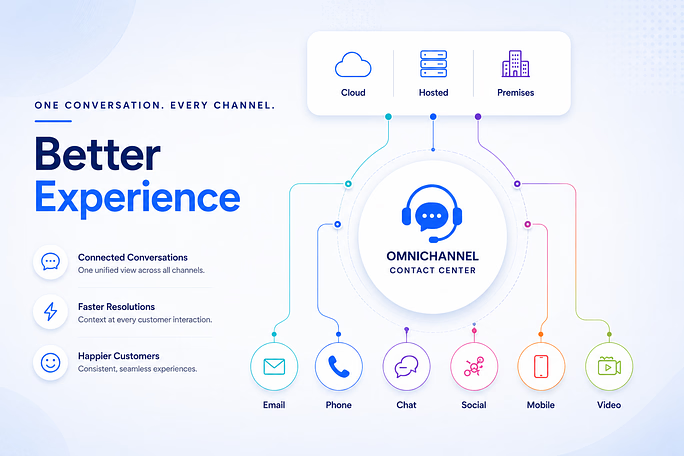
The real problem businesses are facing today. Let us understand this. Most businesses don’t have a communication problem; they just lack the tools. They have too many tools, one app for calls, another for emails, something else for messaging, and then a different platform for video meetings. It works in the beginning. Then the team grows. Messages get missed. Someone replies late. A customer follows up twice. Everything starts slowing down just enough to feel it.
That’s usually when the question comes up. Do we need a better way to manage communication? That’s where unified communication service providers come into play.
What unified communications actually solve
Now imagine this instead. One place for calls, messages, video, and collaboration. No switching between tools. No “where did that conversation happen.” No backtracking. Everything just sits where it should. That’s what unified communication does. It brings everything into one flow. And once that happens, you see it immediately. Teams respond faster. Conversations don’t get lost. Customers don’t have to wait.
Instead of managing tools, your team actually starts focusing on communication.
Why businesses are rapidly moving to unified communication (data-backed insights)
This isn’t just a nice idea. It’s something businesses are actively moving toward because it delivers results.
- Up to 52% improvement in productivity (Source: Forrester)
- Up to 30% reduction in communication costs (Source: IBM)
- 74% of organizations say collaboration improves (Source: Mitel)
- Over 17% CAGR growth through 2030 (Source: Grand View Research)
So when people say communication impacts growth, they’re not exaggerating. It affects how quickly teams move, how customers experience your business, and how well you scale without things getting messy.
What drives a strong unified communications provider
Here’s where it gets interesting. When you look at providers, it’s easy to get pulled into feature lists.
But in reality, only a few things actually matter.
But in reality, only a few things actually matter.
- Everything should connect. Calls, messages, emails, chats. No silos
- It should just work. No downtime, no missed interactions
- It should grow with you, not force you to switch later
- Automation should make things faster, not more confusing
- Security should already be there, not something you add later
If these are in place, everything else becomes easier. If they are not, you will feel it every day.
Top unified communications service providers in the USA
When you start exploring options, you’ll see familiar names. RingCentral, Zoom, Microsoft, Cisco, 8×8, Nextiva, and TeleRain all come up for a reason. Each one is built a little differently. Some are heavy on features. Some keep things simple. Some try to balance cost and flexibility.
The bigger platforms focus on scale and integrations. TeleRain takes a more practical approach. It focuses on making communication easier to manage without adding layers you don’t need.
So instead of asking which one is the biggest, it’s worth asking which one actually fits how your team works day to day.
Top 7 unified communications service providers in the USA
Let’s simplify this, because this is where most people get stuck. All providers look similar at first. But once you actually use them, the differences show up quickly.
- RingCentral
Great if you’re a large organization and want everything in one place with global capabilities. Just be ready for the cost. - Zoom
Easy to use and works well for smaller teams and hybrid setups. Especially strong for video, but can feel limited when you need deeper integrations. - Microsoft Teams
Makes sense if you’re already using Microsoft tools. Everything connects, but getting it all set up can take time. - Cisco Webex
Built for enterprises that prioritize security and reliability. Very stable, but definitely not budget-friendly. - 8×8
Good for businesses that operate globally. Strong international communication, though the interface can take some time to get comfortable with. - Nextiva
Simple, reliable, and widely used by small to mid-sized businesses. Easy to manage, but not the most flexible. - Telerain
A solid fit if you’re growing and don’t want complexity slowing you down. It focuses on keeping communication simple, flexible, and easy to scale without locking you into rigid systems.
And here’s something most businesses realize a little late. You don’t actually need more features. You need fewer problems. That’s where TeleRain quietly stands out. It focuses on making communication work the way your business already does, instead of forcing you to adjust to the system.
What businesses are actually struggling with (and facing)
If you listen to how people talk about this, the questions are surprisingly simple.
- Why are we still missing messages → because tools aren’t connected
- Is this only for large companies → not at all, smaller teams benefit even more
- Is switching expensive → usually not, costs tend to go down
- How do I choose the right provider → depends on your current stage and requirements
- Will this improve customer experience → yes, because responses become faster and more consistent
Put all of this together, and it becomes clear. The problem isn’t tools. It’s how those tools work together.
Unified communications vs traditional systems
Traditional systems feel scattered because they are. They’re harder to manage, harder to scale, and often more expensive over time. Unified systems bring everything into one place. They’re easier to manage, more flexible, and built for how teams actually work today.
That’s why businesses are moving away from older setups. Not because they have to, but because it simply makes work easier.
How to choose the right unified communications provider
If you’re trying to figure this out, keep it simple.
- If your business relies on customer interaction, reliability matters most
- If your team is remote, collaboration becomes important
- If you’re growing fast, flexibility is key
- If security is critical, look for compliance and encryption
Most businesses overcomplicate this decision. The better approach is to focus on what actually makes your day-to-day communication smoother.
FAQs
What are unified communication service providers?
They are platforms that bring calls, messaging, video, and collaboration into one place so you don’t have to juggle multiple tools.
They are platforms that bring calls, messaging, video, and collaboration into one place so you don’t have to juggle multiple tools.
How much do unified communication services cost?
It depends on your setup, but most businesses end up saving by replacing multiple tools with one system.
Which unified communications provider is best in the USA?
There’s no one-size-fits-all answer. It depends on how your business operates and what you need.
There’s no one-size-fits-all answer. It depends on how your business operates and what you need.
Is unified communication suitable for small businesses? Yes, and in many cases, it’s even more useful because it keeps things simple as you grow.
How does unified communication improve customer experience? It helps teams respond faster, stay consistent, and manage conversations without missing anything.
Where TeleRain fits in
This is where TeleRain comes in. It’s not about adding another tool. It’s about making communication easier to manage so your team can focus on what actually matters.
Contact us now.
Contact us now.
Final takeaway
If your current setup feels slower than it should, that’s usually a sign. Things don’t break suddenly; they just start dragging. Unified communication changes that by bringing everything into one place that actually works.
And once that happens, communication stops being something you deal with and starts becoming something that helps your business move faster.