If you walk into most support teams today, you’ll notice something slightly off. The tools look modern. The dashboards look clean. The features look impressive. And yet, the experience still feels slow. Customers are waiting. Agents are switching tabs. Conversations break halfway through. That’s where things start getting interesting. Because the problem isn’t that businesses don’t have tools. It’s that most of these tools weren’t built for how customers behave today.
Customers expect instant replies, seamless conversations across channels, and interactions that feel like you already know them. And if your system can’t keep up with that pace, it doesn’t matter how many features it has.
That’s where the shift toward better customer service software actually begins.
The real gap no one talks about
Most discussions around support focus on tools. New features. Better dashboards. More integrations.
But the real issue sits somewhere deeper. It’s the gap between how customers expect communication to work and how systems are designed to handle it.
Customers think in conversations. Systems still think in tickets.
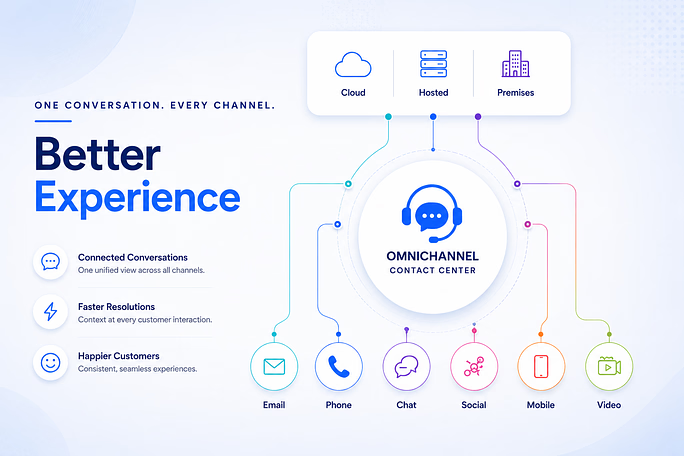
Customers move across channels. Systems treat each one separately.
Customers expect continuity. Systems reset context every time.
Customers move across channels. Systems treat each one separately.
Customers expect continuity. Systems reset context every time.
That mismatch creates friction. And friction doesn’t look dramatic. It shows up in small ways. Slower replies. Repeated questions. Customers explaining the same thing twice.
And here’s why that matters more than ever. 73% of customers now say customer experience is the most important factor when deciding whether to buy from a company (Source: PwC).
So when communication breaks, it’s not just a support issue. It’s a revenue issue.
Why traditional customer service software struggles today
Traditional systems were built for a simpler world. A request comes in, it gets assigned, it gets resolved. Clean and predictable. But today’s reality is very different.
A single customer might start on chat, follow up on email, call when it’s urgent, and expect you to know everything that already happened.
Traditional customer service software struggles here because:
- Channels are disconnected
- Workflows are manual
- Responses depend on queues and routing
Nothing crashes. Nothing breaks. But everything slows down just enough to feel frustrating.
And businesses are starting to feel the impact. In fact, 80% of organizations now expect to compete primarily on customer experience (Source: Gartner).
If your system can’t support that, you’re already behind.
What modern customer service software actually changes
Modern systems don’t try to fix tickets. They remove the dependency on them. Instead of organizing work around requests, they organize it around conversations.
That means:
- One continuous conversation across channels
- Real-time responses instead of delayed handling
- Context that stays with the customer
And this is where things start working the way they should. Teams don’t jump between tools. Customers don’t repeat themselves. Conversations move naturally.
That’s the real shift modern customer service software brings. Less friction, more flow.
And businesses that get this right see real outcomes. Companies that focus on customer experience report profits that are up to 60% higher than those that don’t (Source: CX Index).
What actually matters when comparing customer service software
Most comparisons focus on features, pricing, and integrations. But those don’t tell you what it’s like to actually use the system every day.
A better way to evaluate is this:
- How fast can your team respond without switching tools
- Do conversations stay connected across channels
- Does the system reduce manual work or create more of it
- How quickly can your team get comfortable using it
Because your team isn’t managing software. They’re managing conversations. And the right system is the one that makes those conversations easier. That’s exactly why 90% of businesses today have made customer experience their top priority (Source: CX Index).
Best customer service software for modern businesses
Now let’s get into what most businesses actually care about. Which tools are worth considering?
Zendesk
Strong, structured, and built for scale. Works well for larger teams with complex workflows. But it can feel heavy and takes time to manage properly.
Freshdesk
Simple, clean, and easy to adopt. Good balance between usability and functionality. Works well for teams that want to move quickly.
HubSpot
Best if you want support, sales, and marketing in one ecosystem. Great visibility across the customer journey, though it leans toward CRM workflows.
Telerain
Telerain focuses on simplifying communication instead of adding layers. It connects conversations across channels and helps teams respond faster without managing multiple systems.
For growing businesses, this means fewer delays, less complexity, and smoother communication.
Quick comparison that actually helps
Instead of getting lost in feature lists, think of it this way:
Zendesk works well if you need structure and deep customization
Freshdesk works well if you want simplicity and a quick setup
HubSpot works well if you want everything connected across teams
Telerain works well if you want faster, simpler, and more connected communication
Freshdesk works well if you want simplicity and a quick setup
HubSpot works well if you want everything connected across teams
Telerain works well if you want faster, simpler, and more connected communication
The right choice depends on how your team actually works every day and what are the requirements.
What businesses are actually asking before switching
If you listen to real conversations, the questions are very practical.
Why are we still missing conversations?
Because tools don’t connect
Why does everything feel slower than it should?
Because workflows are manual
Because workflows are manual
Do we need more features?
No, we need better flow.
No, we need better flow.
Is switching worth it?
Yes, because inefficiency compounds over time. And here’s the bigger picture. 80% of leaders plan to increase their investment in customer service (Source: Zendesk CX Trends Report).
So the shift is already happening.
How to choose the right customer service software
If you’re deciding, keep it simple.
- If customer interaction is critical, speed matters most
- If your team is distributed, collaboration matters
- If you’re growing fast, flexibility matters
- If customer experience is key, continuity matters
The right customer service software should feel like it’s taking effort out, not adding to it.
FAQs
What is customer service software?
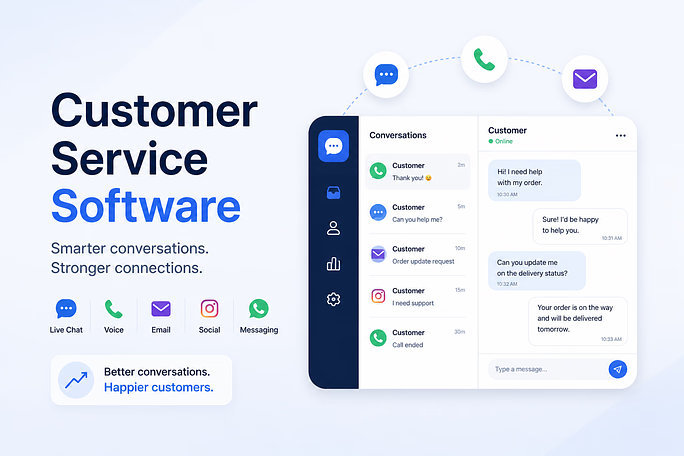
It’s a platform that helps manage customer conversations across calls, chat, email, and messaging in one place.
It’s a platform that helps manage customer conversations across calls, chat, email, and messaging in one place.
Which customer service software is best for modern businesses?
It depends on your team size, workflows, and how you handle communication
Is customer service software worth it for small businesses?
Yes, because it helps avoid communication breakdown as you grow
How does customer service software improve response time?
By connecting channels, automating workflows, and reducing manual work
Can customer service software improve revenue?
Yes, companies that invest in CX see up to 80% revenue growth (Source: Zippia)
What this means for modern businesses
If your current setup feels slower than it should, that’s not random. It’s a signal.
Modern customer service software doesn’t just fix delays. It changes how communication flows across your business. And once that happens, everything improves naturally. Faster responses. Better conversations. Higher retention. Stronger growth.
Because at the end of the day, customer experience isn’t just support anymore. It’s your competitive advantage.
If your current setup feels slower than it should, you’re already seeing the gap. Maybe it’s time to stop adjusting to your tools and switch to something that actually works the way your customers do. That’s where Telerain comes in.
Talk to our experts.