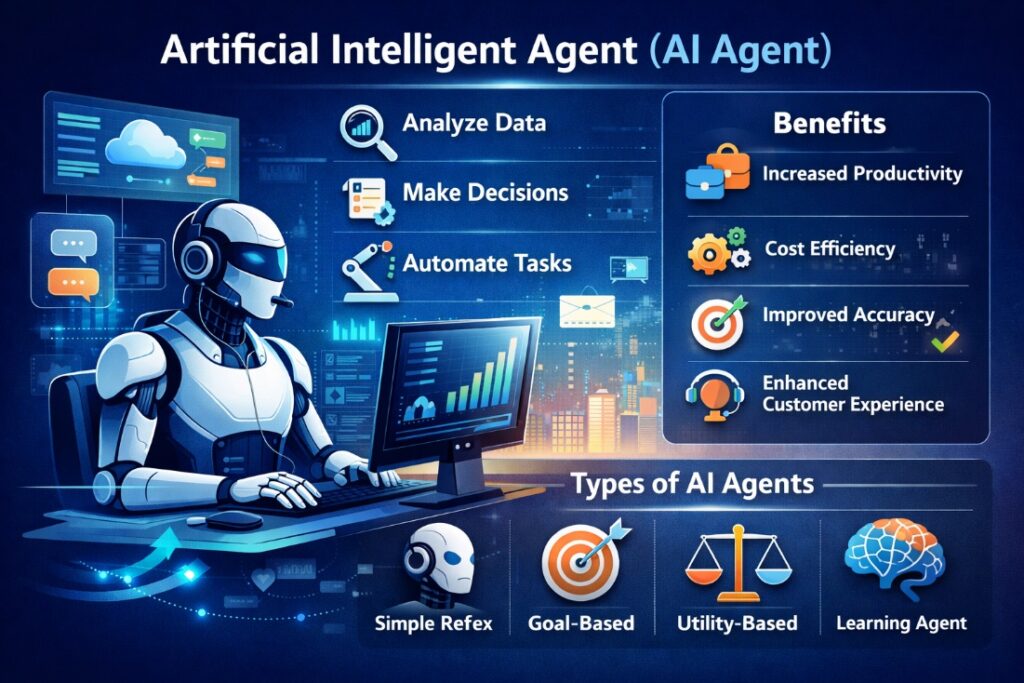
Artificial Intelligent Agents (AI Agents) are transforming how businesses operate, interact with customers, and scale efficiently.
In today’s fast-paced digital environment, organizations are under constant pressure to deliver faster responses, personalized experiences, and seamless operations. AI agents play a critical role in meeting these expectations by automating tasks, analyzing data, and making intelligent decisions in real time.
What is an Artificial Intelligent Agent?
An Artificial Intelligent Agent is a software-driven system designed to interact with its environment, process data, and take actions to achieve specific goals—often with minimal human intervention.
Unlike traditional automation tools that follow fixed rules, AI agents can:
- Analyze real-time data
- Make informed decisions
- Adapt to changing conditions
- Learn from past interactions
They act as intelligent assistants that can handle tasks ranging from customer support to workflow automation and business optimization.
Why AI Agents Are Important for Modern Businesses
Businesses today need to operate faster and smarter while maintaining high-quality customer experiences.
AI agents help organizations:
- Improve response times
- Deliver personalized customer interactions
- Reduce operational workload
- Increase efficiency and scalability
By automating routine processes, AI agents allow teams to focus on more strategic and high-value activities.
How AI Agents Work
AI agents follow a structured process to perform tasks efficiently:
1. Understand Goals and Context
They start by identifying objectives and analyzing available data to create an action plan.
2. Analyze Data and Make Decisions
AI agents gather information from multiple sources and evaluate the best course of action based on insights and patterns.
3. Execute Actions
They perform tasks such as responding to queries, updating systems, routing requests, or triggering workflows.
4. Learn and Improve
Through continuous learning, AI agents refine their performance and deliver better results over time.
Key Capabilities of AI Agents
AI agents are designed to handle complex tasks with intelligence and flexibility:
- Data Analysis: Process large volumes of structured and unstructured data
- Decision-Making: Choose optimal actions based on real-time insights
- Natural Language Understanding: Communicate with users in a human-like manner
- Automation: Handle repetitive and time-consuming tasks
- Personalization: Deliver tailored responses based on user behavior
Types of Artificial Intelligent Agents
Different types of AI agents are designed to handle specific tasks and levels of complexity:
1. Simple Reflex Agents
React to immediate inputs based on predefined rules without considering past data.
2. Model-Based Agents
Maintain an internal understanding of their environment to make more informed decisions.
3. Goal-Based Agents
Focus on achieving specific objectives by evaluating multiple possible actions.
4. Utility-Based Agents
Optimize decisions by considering the best possible outcome among different options.
5. Learning Agents
Continuously improve by learning from past interactions and adapting to new data.
Benefits of AI Agents
Implementing AI agents offers significant advantages across business operations:
Increased Productivity
Automate repetitive tasks and allow teams to focus on strategic work.
Cost Efficiency
Reduce manual effort and optimize resource utilization.
Improved Accuracy
Minimize errors by relying on data-driven decision-making.
Faster Decision-Making
Analyze data in real time to support quicker and smarter actions.
Scalability
Handle increasing workloads without compromising performance.
Enhanced Customer Experience
Provide fast, consistent, and personalized support across channels.
Common Use Cases of AI Agents
AI agents are widely used across industries to improve efficiency and outcomes:
Customer Support
Handle queries, provide instant responses, and escalate complex issues when needed.
Business Process Automation
Streamline workflows such as scheduling, reporting, and data management.
Sales and Marketing
Deliver personalized recommendations and automate customer engagement.
Fraud Detection
Monitor transactions and identify unusual patterns in real time.
Healthcare and Education
Support diagnostics, learning systems, and personalized experiences.
How AI Agents Improve Customer Service Operations
AI agents play a vital role in modern customer support environments by:
- Reducing response and wait times
- Handling high volumes of customer queries
- Assisting human agents with real-time insights
- Delivering consistent and accurate responses
- Enabling 24/7 customer support
By combining automation with intelligence, businesses can provide faster and more efficient service experiences.
Best Practices for Implementing AI Agents
To successfully adopt AI agents, businesses should follow a structured approach:
Define Clear Objectives
Identify specific use cases and goals for AI implementation.
Ensure Data Readiness
Use accurate and structured data to improve AI performance.
Choose the Right Solution
Select AI tools that align with business needs and existing systems.
Start Small and Scale Gradually
Test AI agents in controlled environments before expanding.
Monitor and Optimize Performance
Continuously track results and improve AI capabilities over time.
Final Thoughts
Artificial Intelligent Agents are no longer optional—they are becoming a core component of modern business operations.
By combining automation, intelligence, and adaptability, AI agents help organizations improve efficiency, enhance customer experiences, and scale effectively. Businesses that adopt AI-driven strategies today will be better positioned to compete and grow in the future.
About the Author
The Telerain Insights Team is a group of technology experts, customer experience specialists, and digital transformation consultants dedicated to helping businesses optimize communication and service operations.
With deep expertise in AI, automation, and customer engagement solutions, the team provides actionable insights that empower organizations to deliver smarter, faster, and more scalable service experiences.