Let us ask you something interesting. If you paused right now and traced how your team communicates in a single day, what would that map look like? Chat. Email. Video calls. Cloud phones. File sharing. Internal collaboration platforms. Maybe a few more tucked in between.
Each tool does its job individually. But together? It can feel like navigating traffic just to move a single task forward.
You start a conversation in chat. Continue it in the email. Jump to a meeting. Then search for the file someone shared earlier. Somewhere in that shuffle, momentum slows down.
And here’s the part most organizations do not notice until much later. The slowdown feels normal. But it hurts because productive time is lost due to fragmented collaboration systems. And then, disappearing into switching apps and reconnecting to context.
Now imagine reclaiming that day’s productivity. This is exactly where unified communications service providers step in. Not by adding another tool. Not by creating more complexity. But by simplifying how communication flows across the organization. Because in 2026, communication is not just a function. It is infrastructure. And infrastructure either supports growth or silently slows it.
The hidden cost of fragmented communication systems
Let’s be honest about something. Switching between tools feels routine. Open chat. Jump to email. Launch a meeting. Search for files. Repeat. It feels productive because everyone is busy.
But zoom out.
Fragmentation quietly creates:
- Slower decisions because conversations are scattered
- Repeated explanations because context is missing
- Extra IT workload managing disconnected systems
- Reduced responsiveness to customers
- Communication bottlenecks as teams grow
None of these issues triggers alarms individually. But together, they influence how fast your business can actually move. Experienced unified communications service providers do not treat this as a surface-level inconvenience. They rethink the architecture behind how communication flows. Instead of stacking tools, they align them. That alignment is where efficiency begins to show up.
What unified communications service providers actually deliver
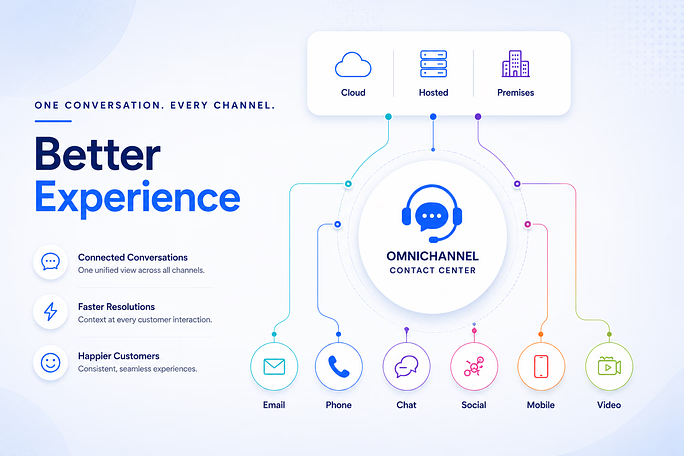
There is a common misconception that unified communications simply means bundling services together. It is much more strategic than that. Forward-thinking unified communications service providers build integrated ecosystems that connect:
- Cloud-based voice systems
- Video conferencing platforms
- Team messaging environments
- File collaboration tools
- Secure mobile access
- Centralized analytics and administrative controls
The real outcome is continuity. When a message evolves into a call, it transitions smoothly. When a meeting ends, the history remains connected. When teams collaborate across locations, the experience feels consistent. You are not adding complexity. You are removing unnecessary friction.
Why demand is accelerating in 2026
This shift is not theoretical. It is measurable. According to IDC research, global spending on unified communications and collaboration (UC&C) platforms is projected to reach $85 billion by 2028, growing at a 5.7% compound annual growth rate (CAGR) from $69.1 billion in 2024.
Why such momentum?
Because hybrid work is permanent. Cloud migration is accelerating. And communication architecture now directly influences scalability. When communication becomes seamless, productivity follows. That is why unified communications service providers are increasingly viewed as growth enablers rather than vendors.
Measurable productivity gains
Now let’s bring this closer to daily reality. When communication systems are unified, teams begin to notice changes such as:
- Less context switching
- Fewer delays starting meetings
- Easier cross-department collaboration
- Faster executive decisions
- Smoother remote coordination
Work feels lighter. Not because expectations drop. But because systems stop interrupting momentum. Productivity improves steadily. And those small daily improvements compound into a meaningful operational advantage. That is where competitive differentiation begins.
Cost optimization without capability reduction
Now comes the question leadership teams always ask.
What does this mean financially?
Let us understand! Those savings typically stem from:
- Eliminating overlapping licenses
- Reducing hardware infrastructure
- Lowering IT maintenance requirements
- Minimizing downtime
- Increasing overall operational throughput
The right unified communications service providers do not reduce capability. They reduce redundancy. It is not about shrinking your environment. It is about refining it so performance improves while costs stabilize.
Supporting hybrid and distributed workforces
Hybrid work is no longer a transition phase. It is how business operates. When teams work across cities, countries, and time zones, communication systems must feel intuitive and reliable. Fragmented tools create uncertainty. Unified systems create stability.
Integrated communication environments enable:
- Reliable remote collaboration
- Secure multi-device access
- Enterprise-grade encryption and compliance
- Scalable cloud performance
When communication flows smoothly, location becomes less of a limitation.
How to evaluate unified communications service providers
Choosing among unified communications service providers should not be based on feature lists. It should focus on architecture.
Key evaluation areas include:
- Integration expertise
- Cloud scalability planning
- Security and compliance frameworks
- Structured migration strategy
- Ongoing optimization support
The right partner builds around how your teams operate rather than forcing teams to adapt to rigid systems. Telerain approaches unified communications with that architectural mindset. By aligning cloud communication infrastructure with operational workflows and long-term growth objectives, Telerain helps organizations reduce fragmentation while strengthening collaboration and cost efficiency.
The strategic shift underway
In 2026, businesses are no longer debating whether unified communication matters. They are asking how quickly they can modernize without disruption.
Organizations that act strategically gain:
- Faster decision making
- Higher employee engagement
- Lower total cost of ownership
- Greater operational resilience
- Stronger customer responsiveness
Communication is no longer background infrastructure. It is a business accelerator.
Frequently asked questions
As organizations evaluate modernization strategies, several practical questions often arise.
What do unified communications service providers actually do differently?
They design integrated communication ecosystems rather than selling isolated tools. Their role includes planning, deployment, integration, optimization, and long-term scalability management.
Are unified communications service providers secure enough for enterprise use?
Yes. Reputable providers incorporate enterprise-grade encryption, regulatory compliance standards, and secure cloud architecture suitable for mission-critical environments.
Can unified communications reduce IT complexity?
Absolutely. By consolidating platforms and centralizing management, unified environments simplify administration and reduce operational overhead.
Are unified communications scalable as businesses grow?
Scalability is one of the core advantages. Cloud-based unified systems allow organizations to expand users, locations, and capabilities without rebuilding infrastructure.
In a Nutshell
Modern business communication cannot rely on scattered systems assembled over time. As organizations scale, complexity increases unless it is intentionally simplified. Unified communications service providers are transforming modern business communication by designing integrated ecosystems that enhance productivity, control costs, and support hybrid workforce models.
In 2026, communication architecture directly influences how efficiently a business operates. The organizations that simplify strategically move faster. And in a competitive environment, speed and clarity are not luxuries, they are advantages. If your communication environment feels heavier than it should, the issue may not be effort. It may be fragmentation.
Telerain works with organizations ready to rethink communication at the architectural level and helps businesses move from disconnected tools to unified performance.