What is Cloud Contact Center Software?
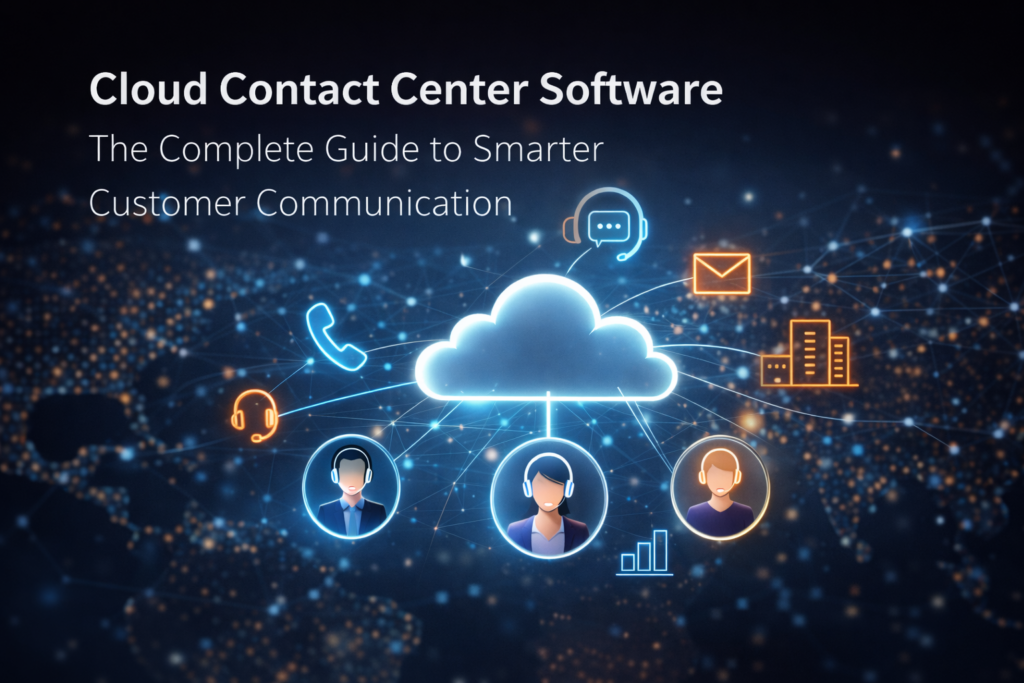
Cloud contact center software is a modern customer communication platform that enables businesses to manage interactions across voice, chat, email, and digital channels—entirely over the internet.
Unlike traditional systems that rely on physical infrastructure, cloud-based solutions operate on secure remote servers. This allows businesses to deploy faster, scale instantly, and support customer service teams from anywhere.
At its core, cloud contact center software helps organizations deliver faster, more personalized, and more consistent customer experiences—while reducing operational complexity.
Why Businesses Are Moving to Cloud Contact Centers
Customer expectations have changed. Speed, personalization, and availability are no longer optional—they’re expected.
Cloud contact center platforms are designed to meet these expectations by combining communication tools, automation, and real-time data into a single unified system.
Key reasons businesses are switching:
- Remote-ready operations with global agent access
- Lower upfront costs with subscription-based pricing
- Faster deployment compared to on-premise systems
- Seamless scalability as your business grows
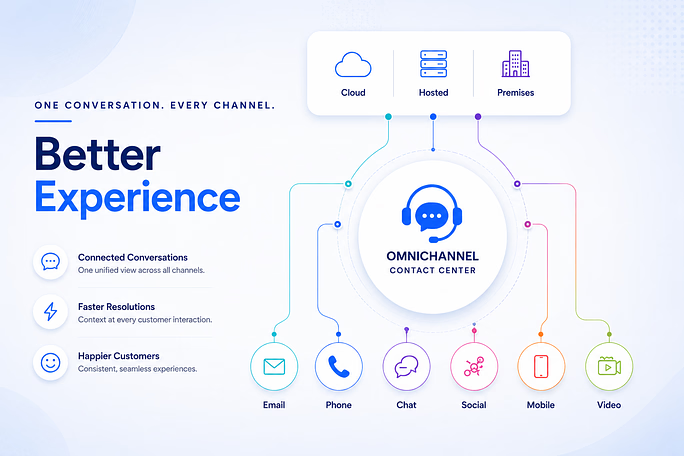
- Unified customer view across all channels
How Cloud Contact Center Software Works
Cloud contact center solutions operate using VoIP (Voice over Internet Protocol) and cloud infrastructure to handle all customer interactions digitally.
Here’s how it works:
- A customer initiates contact via call, chat, email, or social media
- The system identifies the customer and gathers context
- Intelligent routing directs the interaction to the best available agent
- Agents receive full customer history in a unified dashboard
- Interaction data is recorded, analyzed, and stored for insights
This entire process happens in real time—ensuring faster resolution and better customer satisfaction.
Core Features of Cloud Contact Center Software
Omnichannel Communication
Engage customers across multiple platforms—voice, live chat, email, SMS, and social media—without losing context.
Intelligent Call Routing
Automatically route interactions based on agent skills, availability, and customer intent to reduce wait times and improve resolution rates.
IVR (Interactive Voice Response)
Enable customers to self-serve or reach the right department quickly using smart voice menus.
Real-Time Analytics & Reporting
Track performance metrics like call volume, resolution time, and agent productivity with actionable insights.
CRM Integration
Connect with your CRM to provide agents with complete customer profiles, improving personalization and efficiency.
Call Monitoring & Recording
Monitor live calls, review recordings, and ensure quality assurance across your support team.
AI & Automation
Automate repetitive tasks, enable chatbots, and assist agents with AI-driven suggestions.
Key Benefits of Cloud Contact Center Software
1. Scalability Without Limits
Easily scale your operations up or down based on demand—without investing in additional hardware.
2. Cost Efficiency
Eliminate infrastructure, maintenance, and upgrade costs with a predictable subscription model.
3. Improved Agent Productivity
Give agents a single interface with all tools and customer data—reducing handling time and increasing efficiency.
4. Better Customer Experience
Deliver faster, personalized, and consistent support across every touchpoint.
5. Remote Workforce Enablement
Support distributed teams and hire talent globally without location constraints.
Cloud vs On-Premise Contact Centers
Feature | Cloud Contact Center | On-Premise Contact Center |
| Setup Time | Fast | Slow |
| Cost | Subscription-based | High upfront investment |
| Scalability | Instant | Limited |
| Maintenance | Managed by provider | In-house IT required |
| Remote Access | Yes | Limited |
How to Choose the Right Cloud Contact Center Software
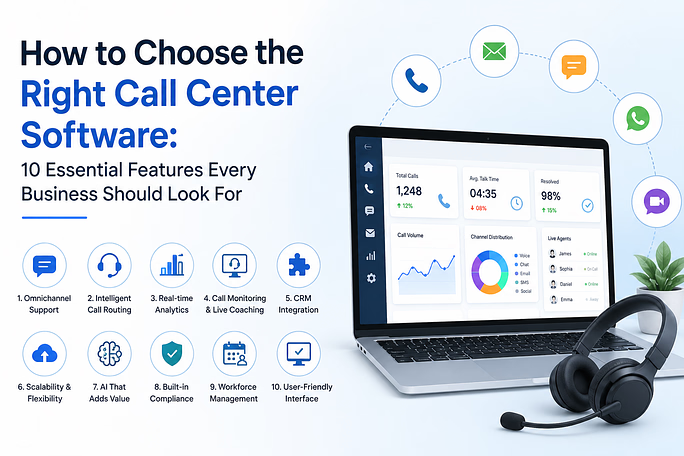
Selecting the right platform is critical for long-term success. Here’s what to evaluate:
1. Feature Set
Ensure it includes omnichannel support, automation, analytics, and integrations.
2. Ease of Use
A simple, intuitive interface reduces training time and improves adoption.
3. Integration Capabilities
Check compatibility with your existing CRM, helpdesk, and business tools.
4. Pricing Transparency
Look for flexible pricing that scales with your usage.
5. Security & Compliance
Choose a provider with strong data protection and compliance standards.
Best Practices for Implementation
To maximize ROI from your cloud contact center:
- Train agents thoroughly on tools and workflows
- Define clear KPIs (response time, resolution rate, CSAT)
- Use analytics to continuously optimize performance
- Start with core features, then scale gradually
- Ensure strong data security protocols
Future of Cloud Contact Centers
Cloud contact center software is rapidly evolving with AI, automation, and predictive analytics.
Emerging trends include:
- AI-powered virtual agents
- Sentiment analysis for real-time insights
- Hyper-personalized customer interactions
- Advanced workforce optimization tools
Businesses that adopt these innovations early will gain a significant competitive advantage.
Why Cloud Contact Center Software is Essential for Modern Businesses
In a digital-first world, customer experience is a key differentiator. Cloud contact center software empowers businesses to deliver faster, smarter, and more scalable support—without the limitations of traditional systems.
Whether you’re a growing startup or an enterprise organization, adopting a cloud-based contact center is no longer optional—it’s a strategic necessity.
Transform Your Customer Experience with Telerain
Deliver seamless, scalable, and intelligent customer interactions with Telerain’s cloud contact center solutions. Empower your team, delight your customers, and grow your business—all from one unified platform.
Frequently Asked Questions (FAQs)
1. What features should you look for in cloud contact center software?
When choosing cloud contact center software, look for features like omnichannel communication, intelligent call routing, real-time analytics, CRM integration, call recording, and AI-powered automation. These features help improve efficiency and deliver better customer experiences.
2. How much does cloud contact center software cost?
The cost of cloud contact center software typically depends on factors such as the number of agents, features required, and pricing model. Most providers offer subscription-based pricing, allowing businesses to pay monthly or annually based on usage.
3. Can cloud contact center software support remote teams?
Yes, cloud contact center software is designed for remote and distributed teams. Agents can access the platform from anywhere with an internet connection, making it easier to hire global talent and maintain business continuity.
4. How does cloud contact center software improve customer experience?
It improves customer experience by enabling faster response times, personalized interactions, and seamless communication across multiple channels. Features like intelligent routing and customer data integration ensure customers get the right support quickly.
5. Is cloud contact center software scalable for growing businesses?
Yes, scalability is one of the biggest advantages. Businesses can easily add or remove agents, features, and channels as their needs grow—without investing in additional infrastructure.